

Innovation often carries an air of uncertainty, but it should never be synonymous with recklessness. The key to balancing risk and reward isn’t avoiding one for the other. Rather, it’s building the operational readiness to evaluate, absorb, and act on risk strategically. Sustainable innovation emerges not from spontaneous leaps but from a culture that knows when, why, and how to stretch its boundaries.
Risk Readiness: Your Operational Safety Net
Routine isn’t the opposite of innovation. In fact, it’s the scaffolding that allows risk to exist without unraveling progress. Reliable processes and repeatable rhythms give teams the clarity and capacity to explore new ideas safely. When the fundamentals are strong, the organization is more equipped to test boundaries without breaking momentum.
This readiness isn’t accidental. Businesses that succeed in high-change environments treat risk capacity like a measurable asset. Instead of asking, “Can we afford to take this risk?” they ask, “Do we have the systems and cultural readiness to navigate it?” It’s an operational question as well as a financial one.
The Risk Spectrum: Not All Bets Are Alike
Innovation risk is rarely all-or-nothing. It lives on a spectrum:
- Low-risk: Experimenting with internal processes, introducing a new meeting format, piloting a small automation.
- Medium-risk: Testing customer-facing changes like pricing adjustments or service model variations.
- High-risk: Entering new markets, launching entirely new business lines, or shifting core platform infrastructure.
Understanding where a new idea sits on this spectrum helps determine how to engage with it. High-risk moves shouldn’t be dismissed outright, but they must be broken down into sequenced actions, each supported by data, feedback, and a clear decision point.
Operational cadence matters here. A quarterly planning rhythm might surface strategic bets worth exploring, while monthly retros can identify low-risk experiments to test. Embedding innovation into these cycles makes space for both boldness and reflection.
When Not to Innovate
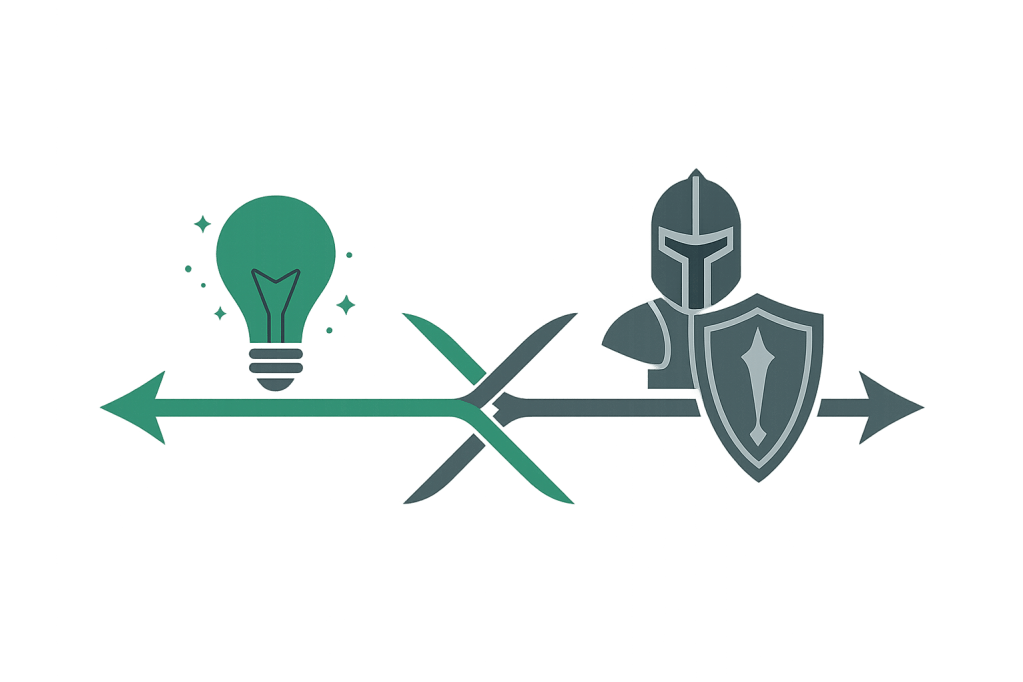
Some of the most mature strategic choices are about timing, not execution. Teams may feel pressure to act quickly in competitive environments, but not all ideas are immediately actionable. Implementing an idea before the organization is ready can backfire by draining morale, confusing customers, or undermining credibility.
Instead of viewing “pause” as a setback, reframe it as preparation. Use recurring touchpoints to evaluate innovation readiness. Consider scheduled events like retrospectives, resource reviews, and team health assessments as opportunities to explore additional questions. Ask:
- Are the core processes stable enough to support change?
- Do we have the right roles and capacity in place?
- Have we defined success clearly enough to know if this will work?
Sustainable innovation is staged, not rushed.
Building a Risk-Aware Innovation Model
Innovation is most powerful when it’s treated like an operational process rather than a personality trait or one-time initiative. A risk-aware innovation model integrates exploration with execution by:
- Structuring experimentation: Define goals, test parameters, and evaluation windows.
- Applying decision frameworks: Use weighted criteria (impact, effort, risk, urgency) to guide prioritization.
- Sharing ownership: Involve cross-functional teams early to widen perspectives and share the risk load.
- Documenting lessons: Treat outcomes as learning assets, not just win/loss records. Revisit them in future planning cycles.
When these practices are built into day-to-day operations, innovation becomes less reactive and more deliberate. This model supports consistency while still pushing boundaries.
Leading Through Calculated Risk
Operational leaders play a central role in balancing risk and reward. It starts with modeling informed curiosity: asking better questions, inviting team input, and showing how risk assessments are made transparently. Encouraging teams to engage with uncertainty, rather than avoid it, builds a culture of trust and shared momentum.
Practical starting points include:
- Adding “what if” prompts to standard team reviews.
- Tracking small bets and follow-ups in planning systems.
- Naming risk explicitly in project charters, not as a liability, but as a variable.
These habits normalize risk as part of good business practice.
Balance as the Goal
Risk isn’t something to fear when your systems are designed to process it. The true balance lies not in minimizing risk, but in maximizing readiness. Sustainable innovation grows when curiosity meets capacity and when bold ideas are backed by steady hands and clear frameworks. That’s how organizations move forward without losing their footing.
October 2025’s weekly content is looking specifically at the balance of innovation and routine for the entire month. Join us next week for Routine vs. Creativity: Finding the Right Mix, where we explore how structured workflows can actually enable innovative thinking.
ElevatedOps is a one-human company—curious, committed, and continuously improving. If this article resonated, feel free to share it or connect with us on LinkedIn. You’ll find all links on our Contact Us page. Thanks for reading—see you next time.
 ElevatedOps Consulting, LLC